


The ancient Stoics lived in a world that looked a lot like ours in some ways… with political hysteria, wars, pandemics, and constant uncertainty. Instead of crumbling under it, they built mental frameworks that made them resilient.
Marcus Aurelius ruled an empire during a plague that killed millions — and stayed calm enough to write a book about peace.
Epictetus was born a slave, his leg crippled by abuse from his master, and yet he taught others how to be free.
Seneca was exiled, betrayed, and ordered to kill himself — and still managed to write, “A gem cannot be polished without friction, nor a man perfected without trials.”
The following are 5 Stoic Mental Models for timeless wisdom. Frameworks so timeless they’ve guided emperors, engineers, and entrepreneurs for two millennia.
Let’s start with the most important one: The Dichotomy of Control.
*If this post was forwarded to you, subscribe for free!
Two thousand years ago, a slave named Epictetus taught us one of the most liberating ideas ever conceived. He said: “Some things are up to us, and some are not.” That’s it. Just two categories. Seems trivial, but let’s dig into it more.
You can spend your whole life trying to control outcomes like promotions, relationships, and recognition. But much of life is out of your control.
Your power lies in how you play the hand you’re dealt.
Marcus Aurelius wrote in his journal
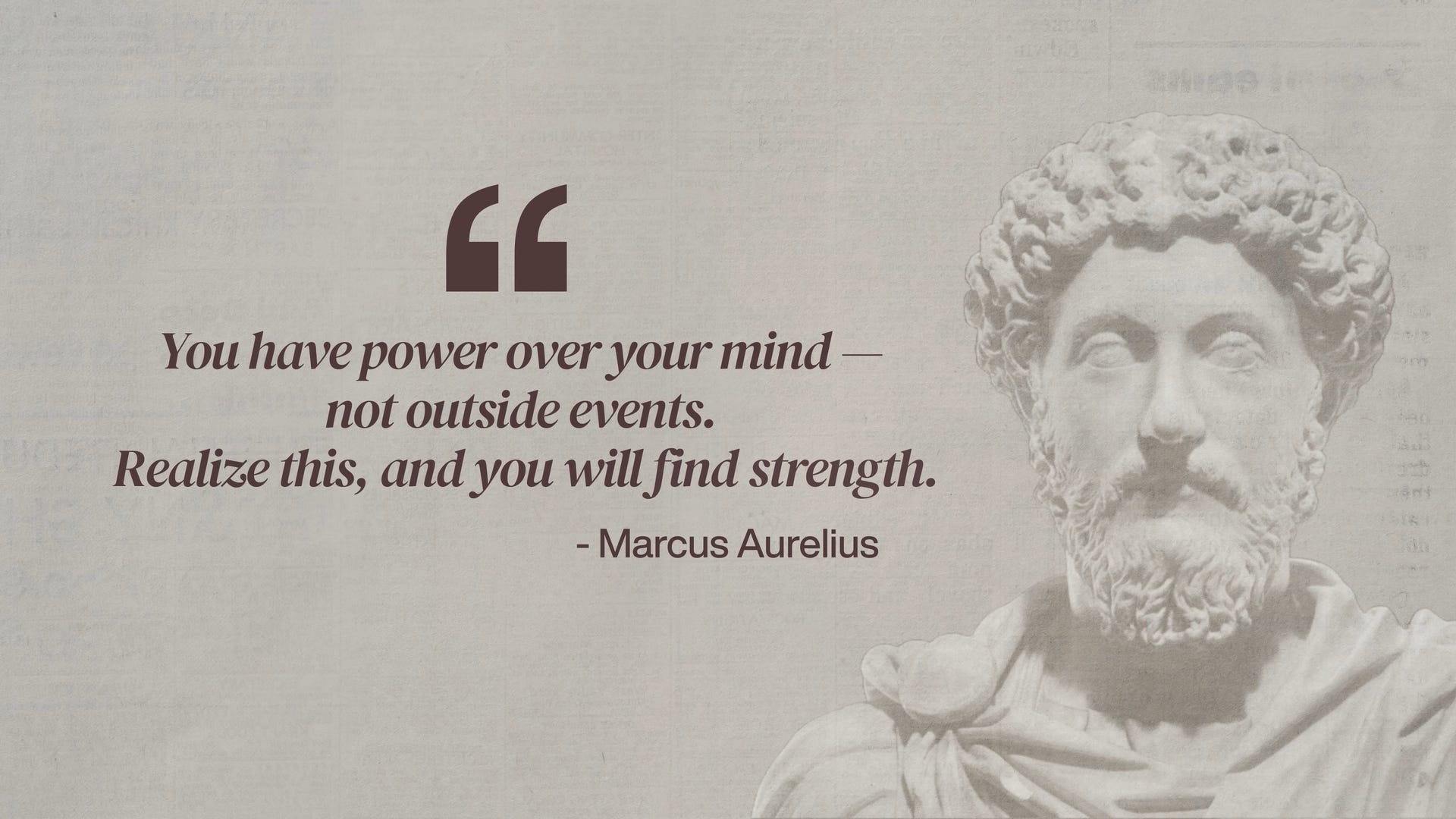
This is what The Dichotomy of Control is all about. When you stop wasting energy on what’s outside your circle of control, you suddenly have more power inside it.
Think of your attention like your phone battery. You only have so much battery each day. You can use the energy in that battery to create change. But, you can also zap that energy trying to change something which is outside of your control.
Every time you obsess over what people think, battery drained.
Every time you replay the past, battery drained.
But every minute you redirect that energy toward something that is within your control, like effort, or decisions — your energy is now invested in something with a possible return.
Ryan Holiday calls this the core of Stoic practicality, and he emphasizes focus on the process, not the outcome.
The Stoics weren’t passive. They weren’t saying,
“Do nothing, accept everything.”
They were saying
“Act where you can make a difference — and detach from where you can’t.”
Instead of casting a wide net with the energy in your battery, we’re focusing it like a laser beam in just a few areas, with a concentrated intensity.
Modern Example
There is a great story from Jeff Bezos’ career that embodies this principle and I want to share it with you. In 2000, Amazon’s stock collapsed by more than 90%. It went from over a hundred dollars a share to barely scraping ten.
Everyone around him was doing damage control on the stock and investor sentiment, things they couldn’t control.
Bezos doubled down on the things within his control. He focused on three inputs.
Customer obsession: Active accounts grew from ~14M → 25M (1999–2001). Repeat purchases kept climbing.
Revenue Growth: Sales rose from $1.6B → $3.1B even as the market crashed.
Operational excellence — making the machine run smoother every day.
And when the dot-com dust finally settled, Amazon had built this infrastructure that would dominate the next two decades.
He told his team, “If we get the inputs right, the outputs will take care of themselves.” That’s the Dichotomy of Control in action.
So he created a framework nearly identical to that of Epictetus.
When things go wrong — and they will — you ask one question
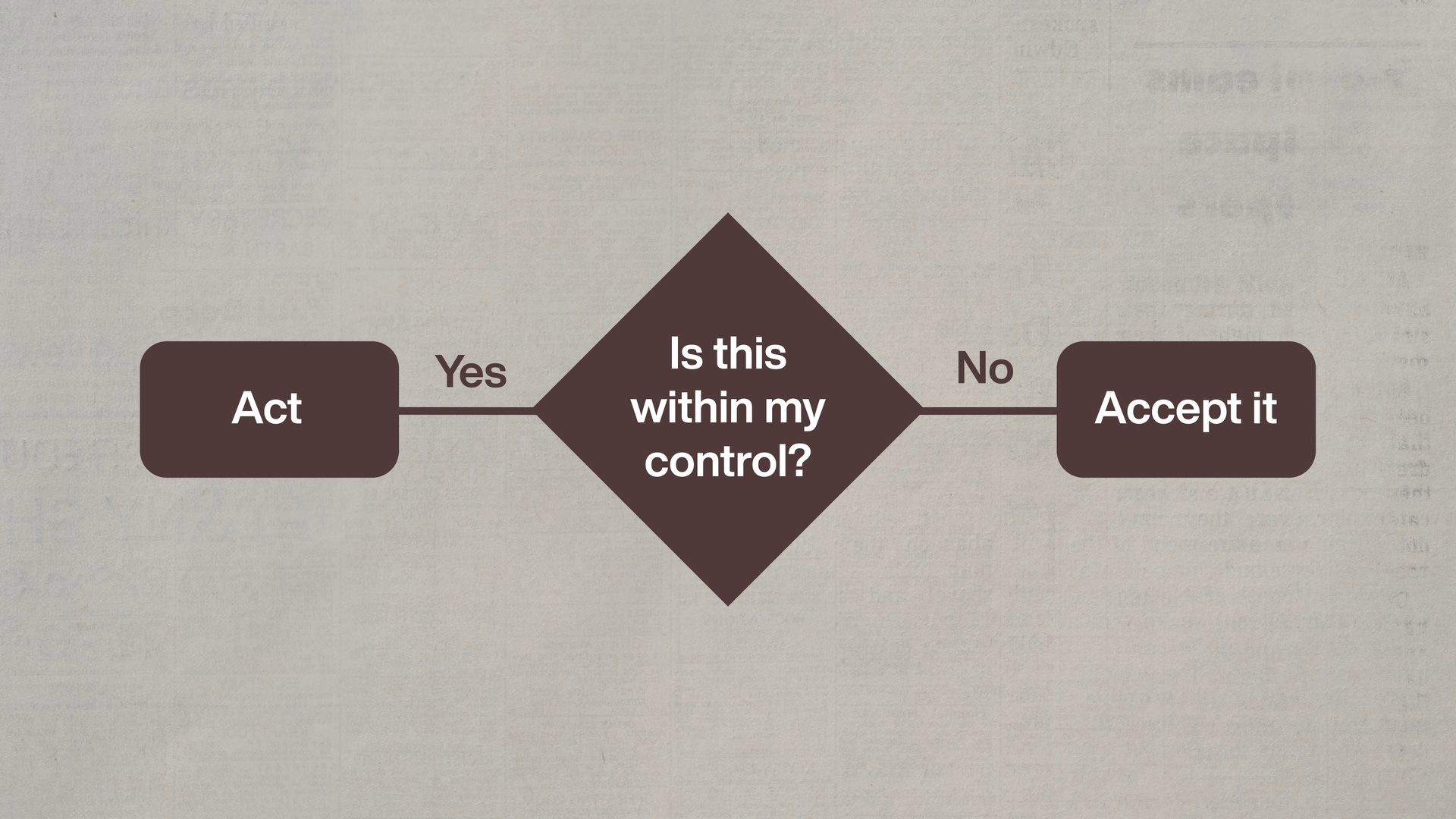
Acceptance isn’t weakness. It’s using the momentum of the world instead of fighting it.
In a world where everyone’s addicted to outrage and anxiety, that’s a competative advantage. While others are reactive, the Stoic stays proactive.
Try this mental model the next time life throws chaos your way:
1. Draw two circles.
– Inner circle: things you can control.
– Outer circle: everything else.
2. When shit hits the fan, ask: Which circle does this belong to?
3. Act decisively inside the inner circle, this is where we’re pointing our laser beam of energy — and release everything outside it.
It’s simple, but not easy. The simple things are often the hardest to get right. Control the inputs. Trust the outcomes.
The Core idea of Amor Fati is, Don’t just accept fate — embrace it as part of your path.
To the Stoics, fate was the hidden architecture of life itself. They didn’t just preach acceptance of what happens, they taught us to love what happens.
Amor Fati translates to “Love of one’s fate.”
“Do not seek for events to happen as you wish, but wish for them to happen as they do happen, and your life will go smoothly.” - Epictetus
“A blazing fire makes flame and brightness out of everything thrown into it.” - Marcus Aurelius
Centuries later, Nietzsche resurrected this principle and made it his life’s compass. He said,
“My formula for greatness in a human being is Amor Fati: that one wants nothing to be different, not forward, not backward, not in all eternity.”
As I’m sure you’ve heard, the grass is always greener on the other side. Social media amplifies this, distorts reality, and makes us envious of the life we think others have. But Amor Fati can help us to love where we are, not just today, but forever.
Modern Example
Now, there are few entrepreneurs’s stories that capture this better than Steve Jobs.
In 1985, Jobs was fired from the company he built in his garage. Overnight, he went from visionary founder to public failure. Everything he’d tied his identity to — gone. And he had every excuse to become bitter, and resentful.
And for a long time he was. Years later he talks about how painful and devastating it was. Thats the word he used… devastating. But instead of retreating, he re-entered the arena.
He built a company called NeXT, and created a computer so ahead of its time that Apple eventually had to buy it — bringing Jobs back as CEO.
He also bought a small computer graphics company from George Lucas and turned it into Pixar. Toy Story, Monsters Inc., Finding Nemo — these films changed cinema, and they made Steve Jobs a billionaire before Apple ever did.
Years later, in his Stanford commencement address, Jobs said:
“You can’t connect the dots looking forward; you can only connect them looking backward. So you have to trust that the dots will somehow connect in your future. You have to trust in something — your gut, destiny, life, karma, whatever — because believing the dots will connect down the road will give you the confidence to follow your heart even when it leads you off the well-worn path, and that will make all the difference.” - Steve Jobs
That’s Amor Fati.
You don’t cling to the path you wanted.
You walk the path in front of you —
and trust the meaning will reveal itself later.
Believe wholeheartedly that one door closing is another path opening —
you just can’t see it in the moment.
The Stoics practiced the ability to step outside themselves — to rise above the noise of daily life and see things from a higher altitude. Marcus Aurelius would picture himself ascending: first above Rome, then above the Earth, then into the stars — until his entire empire looked small against the endless black of space.
The goal wasn’t to escape, but to remind himself that every triumph and tragedy, every insult or bit of praise was temporary.
He wrote: “Look down from above on the countless gatherings and ceremonies… All things are short-lived — both the rememberer and the remembered.” From that height, ego dissolves. Anxiety shrinks.
Think of The View from Above as a mental telescope. When you’re zoomed in, problems look huge. Zoom out, and you see their true size. From altitude, you can distinguish what matters from what doesn’t. In a world addicted to urgency, those who can pause, breathe, and zoom out are able to make wiser decisions, rather than getting caught in the heat of the moment.
Modern Example
Few people in modern times gave us this vantage point more vividly than the astronomer Carl Sagan. In 1990, NASA’s Voyager 1 spacecraft, on its way out of the solar system, turned its camera back toward Earth from 3.7 billion miles away. The image it captured showed our planet as a tiny speck — a “pale blue dot” suspended in a sunbeam.

“That’s here. That’s home. That’s us. On it everyone you love, everyone you know, every human being who ever was, lived out their lives.” - Carl Sagan
Like Marcus, Sagan wasn’t advocating detachment from responsibility; he was inviting a little humility within it. When you can see from that height, priorities change. Things like status start to look silly. Zoomed out far enough, all ambition becomes service.
When you feel trapped by the moment, check out the View from Above. Ask yourself: “How big is this problem from 10,000 feet above? How about from 100 years away?” That’s The View from Above. It’s not about escaping the world, but rather seeing it clearly enough to play your role with a sense of peace.
You can’t read the label from inside the bottle.
To the Stoics, death wasn’t something to fear — it was something to remember. Not morbidly, but just a reminder to carry through life. “Remember you must die.” Marcus Aurelius wrote: “You could leave life right now. Let that determine what you do and say and think.”
When you live with the awareness that your time is finite, trivial things fall away. Ego softens. Priorities sharpen. Memento Mori is a reminder of the one thing we all have in common: we’re going to die.
Think of Memento Mori as a filter for your decisions. When you hold death in mind, every choice gets distilled to its core.
→ What is actually important to me?
“It is not that we have a short time to live, but that we waste much of it.” - Seneca
Is procrastination kind of a form of arrogance — the assumption that you’ll make it to tomorrow? But no matter who you are, tomorrow is not guaranteed.
Memento Mori isn’t about doom and gloom. It’s just another tool to change your perspective. Each morning becomes a gift. Each conversation, a last chance to say what you mean. Awareness of death may be the greatest reminder to be present. Maybe once you realize you’re running out of time, you’ll stop wasting it.
Modern Example
Once again, I gotta kick it back to Steve Jobs. Few modern voices captured this as vividly as he did. In a legendary commencement speech, he told the graduates,
“Remembering that I’ll be dead soon is the most important tool I’ve ever encountered to help me make the big choices in life. Because almost everything — all external expectations, all pride, all fear of embarrassment or failure — these things just fall away in the face of death, leaving only what is truly important. Remembering that you are going to die is the best way I know to avoid the trap of thinking you have something to lose. You are already naked. There is no reason not to follow your heart.”
For his entire adult life, he looked in the mirror each morning and asked himself:
→ “If today were the last day of my life, would I want to do what I’m about to do today?”
And whenever the answer was “No” too many days in a row, he changed course.
That’s Memento Mori in practice. Steve Jobs used mortality as a decision framework. It stripped away pride, politics, and posturing — leaving only what mattered.
When you feel pulled in a thousand directions, whisper it to yourself, “Memento Mori.” Not to scare yourself — to steady yourself.
When you remember that your time is finite, you finally start spending it a little more intentionally. Every breath becomes a choice. Every day becomes a life. And just having that little sense of awareness is what turns ordinary living into something storyworthy.
The stoics called the practice Premeditatio Malorum — “the pre-meditation of evils.” Each morning, they’d imagine life falling apart: a voyage lost to storm, a friend’s betrayal, a sudden illness or exile. Seem’s kinda weird right?
“He robs present ills of their power who has perceived their coming beforehand.” - Seneca
By confronting worst-case scenarios in advance, the Stoics learned that most fears shrink under scrutiny — and the rest are survivable. Now, don’t mistake this for pessimism. It’s not that, it’s preparedness. Once you’ve rehearsed the storm, you don’t panic when the clouds do appear.
Think of Premeditatio Malorum as mental risk management. Visualizing failure before it happens. The Stoics practiced adversity in the mind, being proactive instead of reactive. When the unthinkable occurs, you’ve already mapped your exits.
Modern Example
No modern institution embodies this better than NASA. Before a single astronaut leaves Earth, engineers at Mission Control spend months inside simulation labs, running catastrophe after catastrophe. Fires. Power loss. Oxygen leaks. Navigation failure. Every nightmare is rehearsed.
So when Apollo 13 launched in 1970 and an oxygen tank exploded 200,000 miles from Earth, they didn’t panic. “Houston, we’ve had a problem.” The words were calm. Inside Mission Control, teams worked through binders of failure protocols, re-creating scenarios they’d already lived hundreds of times in simulation. They built a carbon-dioxide scrubber out of spare tubing, tape, and ingenuity. In the end, they guided the crippled spacecraft safely home.
That was Premeditatio Malorum manifested: practice disaster so thoroughly that when it comes, you simply follow the plan. You’ve built mental resilience, and are better prepared for adversity.
The mind that’s already met misfortune isn’t surprised by it. You can’t prevent every failure, but you can reduce the likelihood that they catch you unprepared.
Now in my personal opinion, I think that this one can be taken too far. The anxious mind can dwell on doomsday scenarios a bit too much, and forget to live.
“I’ve suffered a great many catastrophes in my life. Most of them never happened.” - Mark Twain
So I would push back a little on this: I think it’s important to build fail-safes and layers of redundancy into your life for when shit hits the fan. But I think it would be a mistake to spend so much time and energy on what might go wrong, that you forget to live.
Remember momento mori? You could be dead tomorrow. How would you like to spend your last day on Earth? Let me know in the comments.
The Sunday Systems Weekly Planner (Free)
Here’s another mental model video!
Fyi,Most books on stoics were written almost 1500 years after greek.
Great summary, and an excellent reminder of some timeless wisdom.