


A few weeks ago, I came across this post.
To live in paradox is to pursue life’s endeavors in their fullness, and in opposite areas.
The middle is a compromise. And when you compromise, you get neither, not both.
This spectrum exists across many areas of life. It can be found in Geography, Temperature, Noise, Food, etc.
Let’s use the example of Weightlifting.
Left: Active Recovery, Sauna
Middle: Going to the gym, but barely breaking a sweat
Right: High Intensity Training, Hypertrophy
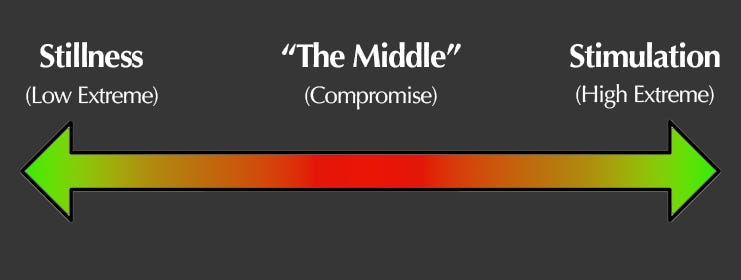
Living in paradox means seeking life at its edges. It’s not a contradiction. The edges challenge us. The middle sedates us.
“But there is no energy unless there is a tension of opposites; hence it is necessary to discover the opposite to the attitude of the conscious mind.” - Carl Jung
Embrace The Extremes, Reject The Middle
Right now, one of the paradoxes in my life is noise.
I love music festivals—the kind where bass rattles your bones, where you're vibrating in a sea of strangers under a shared sky.
I also love bowhunting—sitting stone still in a tree stand for hours, listening for the faintest crunch of a leaf.
In a way, these experiences are opposite one another. They have almost nothing in common, and the Venn diagram overlap of people who take part in both activities is small. As crazy as it might sound, the juxtaposition of these two experiences has given me a greater appreciation for them, and even for the sounds I encounter day to day. You don’t find this in sterilized environments built for everyone. You find it at the edges.
The more distance between your experiences, the more meaning each one holds.
Living in Paradox (across several areas of life)
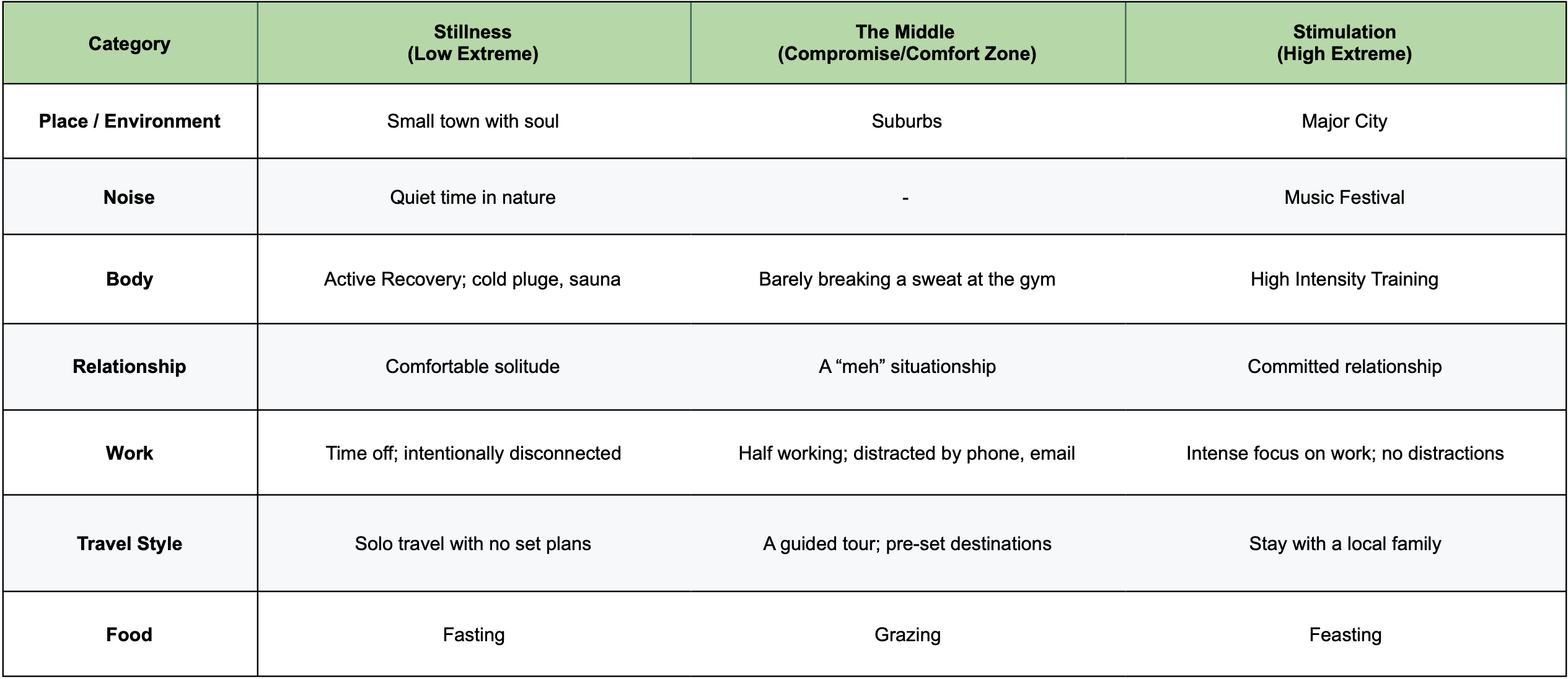
The middle is sold to us as balance. As the best of both worlds. As an optimized life.
It’s easy, familiar, and packed with company—but there is no growth here.
Because growth doesn’t happen in environments designed for comfort.
It happens in contrast. In tension. In the stretch between things.
The middle is where you fit in. The extremes are where you find yourself.
This became obvious to me when I noticed how often my brain solved problems while I was doing something completely unrelated.
Not working harder. Just living differently.
A problem in my business would get solved after a silent morning walk in the woods.
A communication issue in a relationship would resolve after a fumbled interaction, trying to buy bread from someone who didn’t speak my language.
Thinking outside the box starts by stepping outside of it.
Metaphors are hiding everywhere. And your brain knows how to recognize them if you give it contrast to work with.
Sometimes that contrast is as simple as silence.
The Importance of Doing Nothing
Some of the most powerful creative shifts don’t happen when you’re “on.” They happen when you stop trying.
Tapan Desai wrote a beautiful piece about this, drawing on John Cleese’s concept of the Tortoise Mind—the part of our brain that continues to work on problems long after we’ve consciously let them go.
“Our minds continue to work on a problem long after we’ve stopped thinking about it consciously.” — John Cleese

That’s the gift of stillness: it clears space for unexpected insight. It’s about letting your subconscious reshuffle ideas, draw new connections, and surface insights you couldn’t have brute-forced into existence.
You’ve probably felt this.
A name pops into your head the moment you stop trying to remember it.
A creative idea hits you while walking alone.
A relationship disconnect finally makes sense… while you’re doing the dishes.
When you remove pressure, your brain starts to play.
Neuroplasticity: Why Living in Paradox Works
The beauty of this whole idea—living at the edges, moving between extremes—is that it’s how your brain is designed to grow.
Neuroplasticity is the brain’s ability to rewire itself in response to experience. And the fastest way to activate it? Novelty. Challenge. Contrast.
“The brain is like a muscle: the more you use it in new ways, the stronger it gets. Novelty sparks growth.” — Dr. Michael Merzenich
That means doing unfamiliar things. Switching gears, changing environments, chasing edges.
All of it sends the same message to your brain: pay attention.
And when your brain pays attention, it starts forming new neural pathways. Connecting the dots across your vastly different experiences.
Stillness works one part of the mind—depth, introspection, pattern recognition.
Stimulation lights up another—energy, action, momentum.
When you expose yourself to both ends of the spectrum, you give your brain more to work with. More contrast. More raw material for insight.
How To Get Started
Living at the edges isn’t about being extreme for the sake of it.
It’s about seeking contrast on purpose—because contrast sharpens everything.
Stillness teaches you how to listen. Stimulation teaches you how to move. And a life lived only in the middle forgets how to do either.
So how do you start living at the ends of the spectrum?
You don’t need a five-step plan. But you do need to be willing to:
get uncomfortable.
be different
do it alone.
Start with curiosity.
Go somewhere alone. Say yes to something that scares you.
Spend an afternoon without your phone. Dance for hours. Sit in silence. Have a hard conversation. Go to bed early. Stay out too late.
Not all at once. But enough to remind your brain—and your soul—that you’re alive.
Remember: you can just do stuff.
Get my Sunday Systems Worksheet while it’s still free! (I guarantee you’ll get 50% more done in a week)
Two of my favorite places are a packed sports stadium and alone with my camera in the wilderness. I've never thought of the two past times quite like this before. Thank you.