


The Dip
Every endeavor starts with a honeymoon phase. Especially when you launch something personal, and the first wave of reactions comes from people who love you.
I’ve seen this happen over and over. You share your idea online, and the response is incredible. Friends, family, even distant acquaintances come out of the woodwork to cheer you on. It feels like you’ve struck a nerve—like you’re onto something big.
But the truth is, that early attention is often misleading. It’s an artificial high, propped up by affection, novelty, and the human instinct to encourage people we care about. What comes next… is the Dip.
The Dip is when reality sets in. When the social media applause dies down, and you realize you haven’t actually found your audience yet—you’ve just been surrounded by a support group.
It’s like hiking over a ridge, catching your breath, and then realizing that the real mountain you have to climb is still ten miles away.
That’s exactly what happened with my podcast, Breakfast with Nana. When I launched it, the response blew me away. I had no idea so many people would be drawn to the idea of a 25-year-old interviewing his 95-year-old grandmother.
And that’s the thing—they loved the idea. The concept was heartwarming. People weren’t just liking it—they were emotionally moved. They told me they wished they had something like this for their own parents or grandparents.
So I listened. I built something. I turned that love into a product: Legacy Preservations—a service that would help other families create high-quality interview keepsakes of their own.
The interest was there… or so I thought. But what I’d mistaken for intent was really just admiration. The problem wasn’t the concept—it was the commitment. The process asked too much of people. It required them to organize, to prepare, to involve their loved ones in a way that felt overwhelming. This was going to be harder than I thought.
That’s when the Dip hit. The honeymoon was over. And suddenly, the mountain to sustainability wasn’t just steep—it was barely even visible.
When to Quit and When to Stick
Author Seth Godin has written about this concept, and makes a sharp distinction: Strategic quitting is not the same as failing. In fact, the people who succeed the most are often the ones who quit the most things—but they quit the right things at the right time.
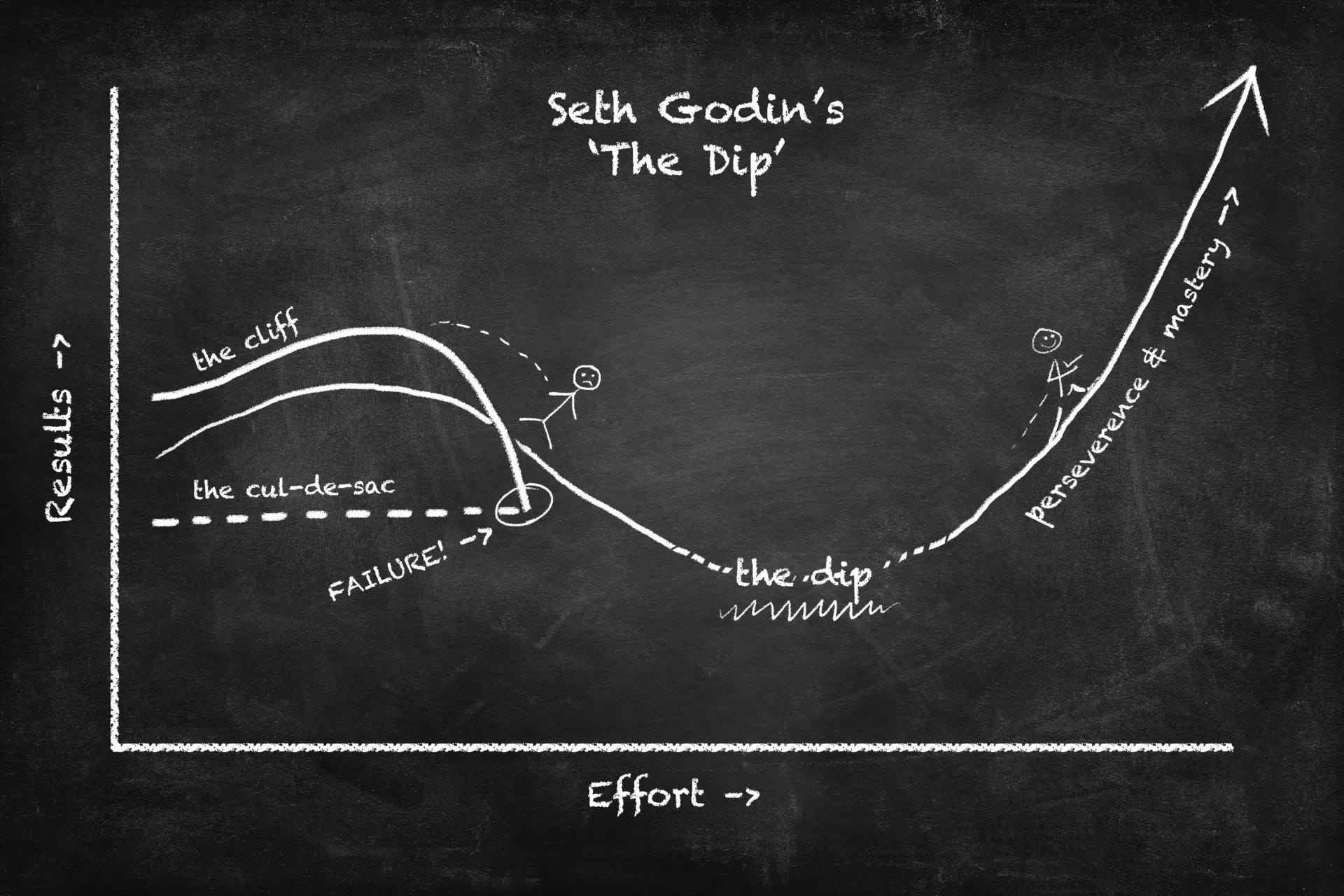
According to him, most endeavors fall into one of three categories:
The Dip – A stretch of difficulty that’s worth pushing through, because there’s something rare and valuable on the other side.
The Cul-de-sac – A dead-end. No matter how hard you push, it won’t lead to significant progress.
The Cliff – Where things might feel fine now, but the crash is inevitable. (Think unsustainable business models or toxic partnerships.)
The hard part is knowing which one you're in.
The Dip demands patience. The Cul-de-sac demands a pivot. The Cliff demands an exit.
What I took from the book—and what I try to practice now—is to ask one powerful question:
“If I knew everything I know now… would I still start this project today?”
If the answer is no, and I’m only continuing out of guilt, sunk costs, or pride—that’s a sign to walk away.
But if the answer is yes, and I’m just tired, scared, or doubting myself… that’s probably the Dip.
And here’s the truth:
The Dip doesn’t mean the reward is right around the corner, it’s more like the opposite. It means you’ve reached the start of the long road. The quiet, unglamorous stretch where most people give up—not because they weren’t good enough, but because they weren’t patient enough.
We like to think the market weeds out the weaker players. But part of the price of admission is time. The Dip is how the market separates the dabblers from the committed. The winners aren’t just the most talented—they’re the ones willing to stick it out and keep improving, long after the initial applause has faded.
The Ones Who Stuck It Out
James Dyson built 5,126 prototypes of his vacuum before one finally worked.
That’s not a metaphor. He literally failed over five thousand times. He spent years in debt, alone in his workshop, with nothing to show for it except conviction. If the market rewards anything, it’s this: the willingness to suffer through the Dip longer than most people are willing to try.
Same with J.K. Rowling. A single mom on government assistance, rejected by a dozen publishers, she still kept writing. She didn’t wait for permission. She didn’t need applause. She believed there was something worth seeing through to the end.
Neither of them was an overnight success. They just survived the part that everyone else quits.
And in case you’re wondering if I’m still sticking it out with Legacy Preservations—the short answer is: no.
I asked myself the question Seth Godin suggests: “Knowing everything I know now, would I still start this project today?” The answer was no. But I wouldn’t have that answer unless I’d started in the first place.
And while the business didn’t take off, I walked away with some incredible consolation prizes:
– I got to preserve meaningful conversations with my grandparents—videos that will outlive both of us and give future generations a chance to know them.
– I dipped my toes into podcasting, and loved it.
– I built a full studio, originally meant for Legacy Preservations, that’s now powering my YouTube channel. One of the videos I shot there has over 150,000 views. (Watch Here)
– And most importantly, by quitting, I freed up my time to pursue what I’m doing right now: this newsletter and the YouTube channel.
Sometimes quitting is how you make space for what’s next.
The Book That Gave Me Language for All This
I didn’t have language for this pattern until I read The Dip by Seth Godin.

It’s a tiny book, maybe 90 pages, but it gave me a framework that’s changed how I think about quitting, sticking, and what it takes to cross the threshold between “interested” and “all in.”
And no, this isn’t one of those “never give up” pep talks. The Dip is more nuanced than that. It's about learning to quit smarter. To quit things that won’t reward your effort, and double down on what will.
Because sometimes quitting is wisdom. And sometimes sticking is bravery.
The art is knowing which is which.
And if you’re in the middle of The Dip right now—and running around like a chicken with its head cut off—there’s one system that’s helped me more than anything:
It’s called the Not Now List, and it changed the way I handle distractions, ideas, and staying focused on what matters. I wrote an article about it below. Please don’t get offended by the title.

Get The Dip by Seth Godin Here
Try my Sunday Systems Worksheet (I bet you’ll get 50% more done in a week)
👉 Download the Sunday Systems worksheet here.