

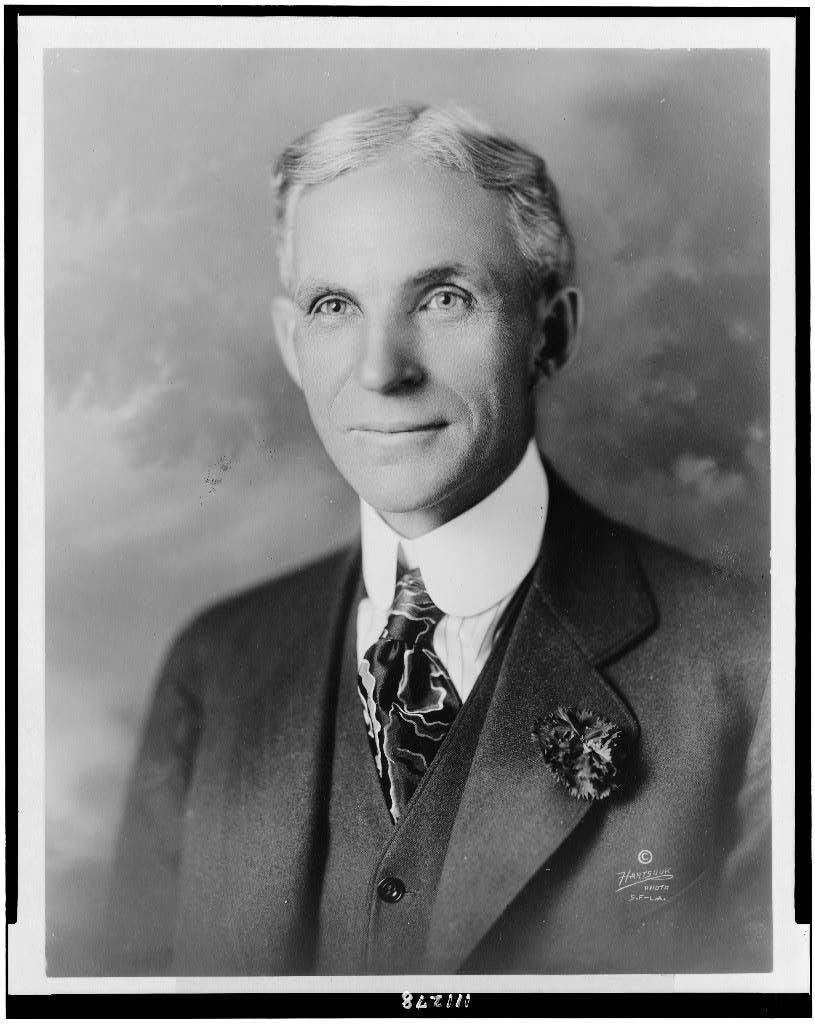
I just finished reading an autobiography on Henry Ford, one of the greatest innovators and industrialists of all time. He's responsible for bringing automobiles to the mass market, and he also invented some incredible manufacturing processes, most notably the moving assembly line.
The reason I wanted to cover Henry Ford is not just because of what he accomplished, but how he was able to accomplish everything that he did.
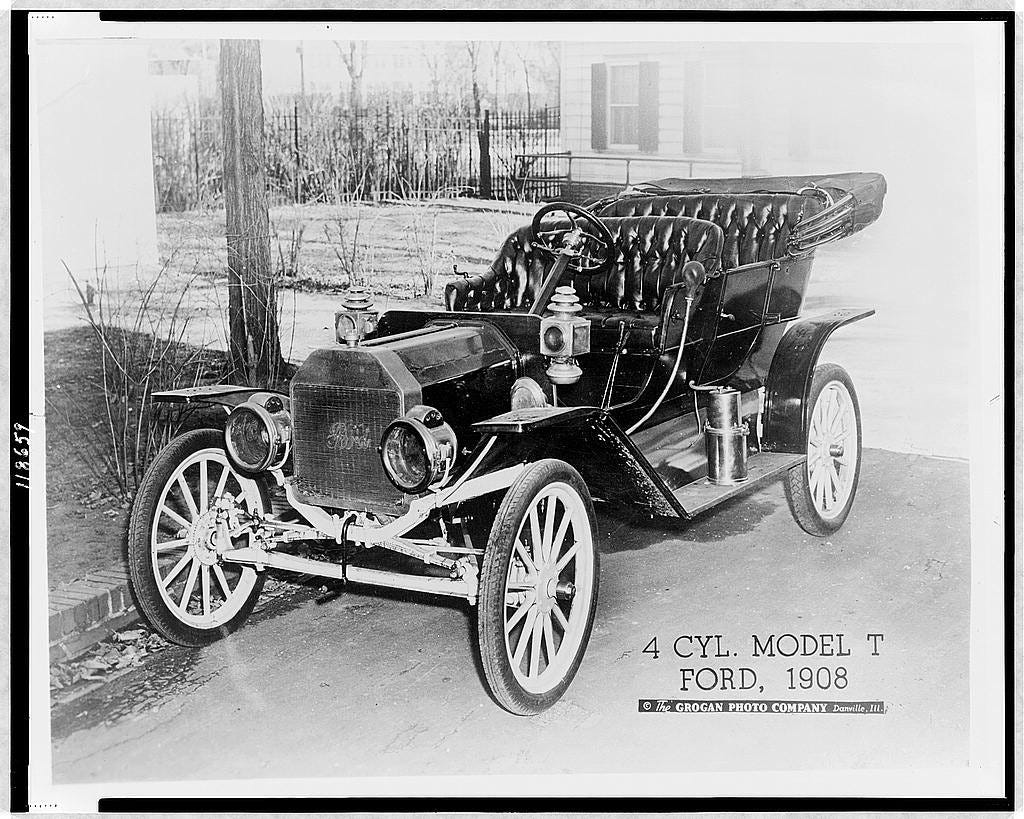
Ford denounced a whole bunch of greedy and anti-competitive business philosophies that were thought to give you the best chances of success at the time. He's the type of innovator that I would call an industrial idealist - someone who is completely devoted to improving the quality of life of the customer. He believed that this didn't have to come at the cost of his own success and that the two were actually aligned.
By following this philosophy relentlessly, Ford was able to build a global manufacturing empire better than everyone else in the entire world.
Ford's playbook for innovation is interdisciplinary. It can be applied to any practice.
So I'm breaking this down into four moves you can take into your own life.
Service Before Profit
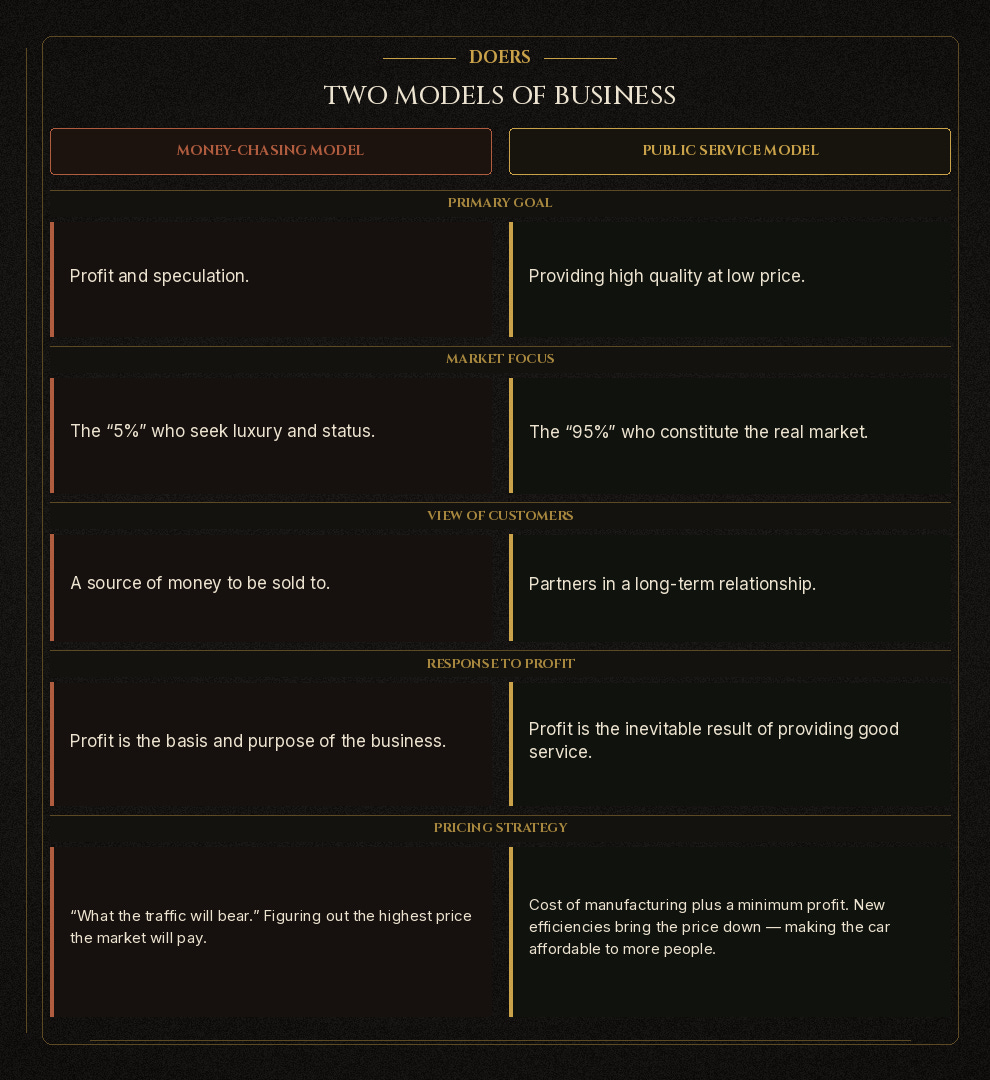
Ford's premise is blunt. Service is not charity. It is the natural code of a durable business. Industry exists to produce high-quality goods at the lowest possible price, not for the five percent who can pay for custom work, but for the ninety-five percent who make up the bulk of the market.
“Profit must and inevitably will come as a reward for good service. Money, machines, and goods are useful only as they set people free to live. Speculating in things already produced is not business. It is more or less respectable graft. A company built on service stays useful because it is still producing for consumption.”
The Principle
Lead with service. Treat profit as the reward, not the purpose.
Waste and Greed
Ford named two enemies that keep workers and customers from getting a full return: waste and greed.
Waste is carelessness and poor planning.
Greed is nearsightedness that distorts production to serve the producer instead of the consumer.
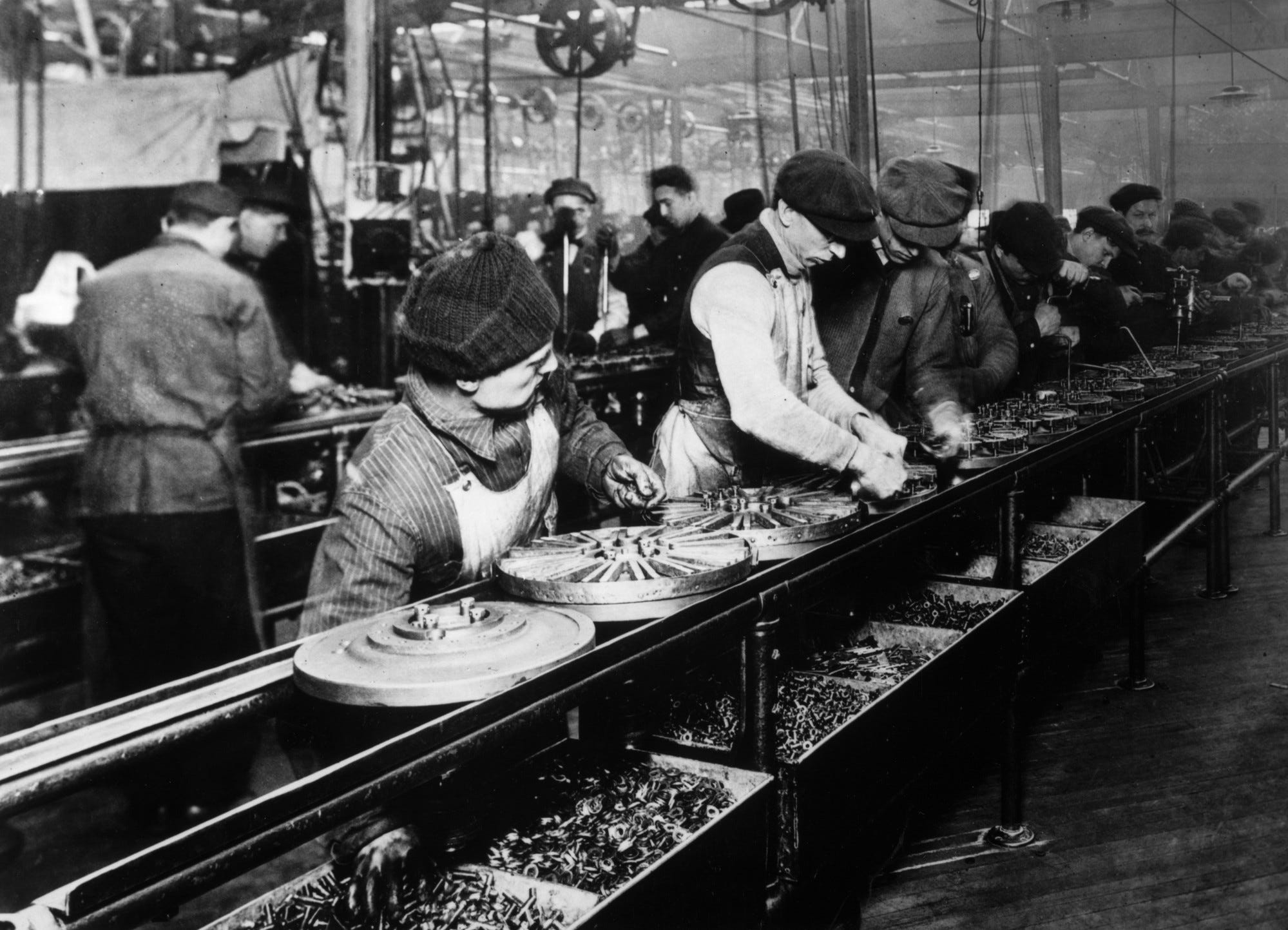
Inside the factory, he saw walking as a tax. If a man spends half the day fetching parts, you are paying for the motion, not for the product. Bring the work to the men instead of the men to the work. He installed moving lines and made sure the parts arrived at waist height the worker did not have to bend over.
The Principle
Eliminate wasted motion, weight, material, and human energy - then transfer the savings into a lower price.
Failure vs. Fear of Failure
“Failure is only the opportunity more intelligently to begin again. There is no disgrace in honest failure; there is disgrace in fearing to fail.”
Thinking first of money brings on fear of failure. That fear blocks competition, blocks new methods, and freezes people in the grooves of habit. Businessmen go down with their businesses because they like the old way so well they cannot bring themselves to change.
Ford was allergic to experts - the person who can perfectly explain why something cannot be done. He got rid of people as soon as they thought themselves experts. The person who really understands the job sees how much is still undone, and keeps pressing forward.
“We get some of our best results from letting fools rush in where angels fear to tread.”
He even refused to keep a record of all his failed experiments, because a written history of what didn’t work becomes a chorus that it simply cannot be done.
The Principle
Honest failure is the tuition of innovation. Letting fear prevent you from taking action is disgraceful. Beware of “experts.”
Disregard Competition
Time spent in fighting competition is wasted; it had better be spent in doing the work.
Ford’s reasoning was that a company’s vital resources—time, energy, and capital—are finite. Diverting any portion of these resources to sabotaging a rival is a distraction that lessens an organization’s ability to serve the public. His opinion was that the marketplace is not a battlefield to be won by force, but a meritocracy where the best producer naturally succeeds.
“Whoever does a thing best ought to be the one to do it. It is criminal to try to get business away from another man—criminal because one is then trying to lower for personal gain the condition of one’s fellow man—to rule by force instead of by intelligence.”
During this time period, many manufacturers focused on high-margin luxury goods for the elite. People figured out that if you sold to rich people, you could produce fewer units and make a great profit on each unit sold. Ford, on the other hand, had a different business model, which he called the service model.
The service model shifted the focus toward the emerging middle class as well as the working class, identifying them as the true engine of the American economy. Ford called this the 95%.
In order to serve this market, a business must prioritize high quality and low prices over immediate money-making.
The most significant test of Ford’s philosophy on this was a legal battle over the Selden Patent.
In 1879: George Selden, a patent attorney, filed an application for a “road locomotive.” He kept this application alive for 16 years without ever producing a working vehicle.
1895: The patent was granted as a “combination patent,” claiming rights over the specific combination of a carriage body, a propelling mechanism (clutch and gear), and an internal combustion engine.
1903: The patent was used to demand royalties and decide who could legally manufacture automobiles. The way Ford saw it, this was a cartel of automobile manufacturers trying to monopolize the car industry by controlling prices and restricting output. When Ford refused to join their association, the group sued him.
1909: Originally, the lower court ruled against Ford. The Association subsequently advertised that any consumer buying a Ford car was liable for legal prosecution. That is part is nuts, they were literally running ads saying that if you purchased a Ford car, you we’re going to be prosecuted.
In response, Ford took out four-page ad in the major newspapers across the country, offering an unconditional financial guarantee: He pledged the entire net worth and assets of the Ford Motor Company, which, at the time was ($6,000,000) to defend any customer sued by the patent holders. Then to further satisfy any buyers who feared that the lawsuit might bankrupt Ford Motor Company, he purchased an additional $6,000,000 bond from an outside company.
In the end, Ford’s willingness to risk his entire company to protect his customers turned public sympathy overwhelmingly in his favor. The guarantee gave buyers so much confidence that sales nearly doubled to over 18,000 cars that year, and fewer than fifty buyers ever actually bothered to request the physical bond papers when buying from Ford.
He eventually won the lawsuit on appeal. The court’s decision proved that “paper patents” could not obstruct the progress of real manufacturing, effectively ending the attempt to monopolize the auto industry.
This example falls into what Ford called Destructive Competition. This is fueled by an obsession with money and the desire to crush others to gain a monopoly. In this mindset, the competitor is an enemy to be eliminated through legal maneuvers or artificial price controls. Ford said that this actually limits the market and harms the consumer in the end.
Ford believed that true progress comes from a generous rivalry. This is the drive to excel in service. The goal is not to hurt the other man, but to serve the public more effectively. If another company performs a task better, it is seen as an invitation to improve one’s own methods.
Progress is only possible when a leader refuses to believe they have found the “perfect method” and remains willing to wake up every morning looking for a better way to do the job.
What to steal
Lead with service. Treat profit as the reward, not the playbook.
Cut waste like it's a tax on the customer's life: materials, energy, weight, motion. Push the savings into price.
Treat failure as data. Fear of failure is the real failure.
Beware of Experts
Ignore the competition. Focus on creating a good product.
Watch the episode: https://www.youtube.com/watch?v=KnL9Aabh3kY
Cheers!
- Dante
My Products
The Sunday Systems Weekly Planner


