


0:00 - Alexander's Father is Assassinated
0:41 - Calculated Destruction of Thebes
6:00 - Dismantling The Persian Navy
16:10 - The Night Before Gaugamela
23:39 - The Battle of Gaugamela
31:39 - The Helmet of Water
Artifact by Kevin MacLeod is licensed under a Creative Commons Attribution 4.0 license. https://creativecommons.org/licenses/by/4.0/
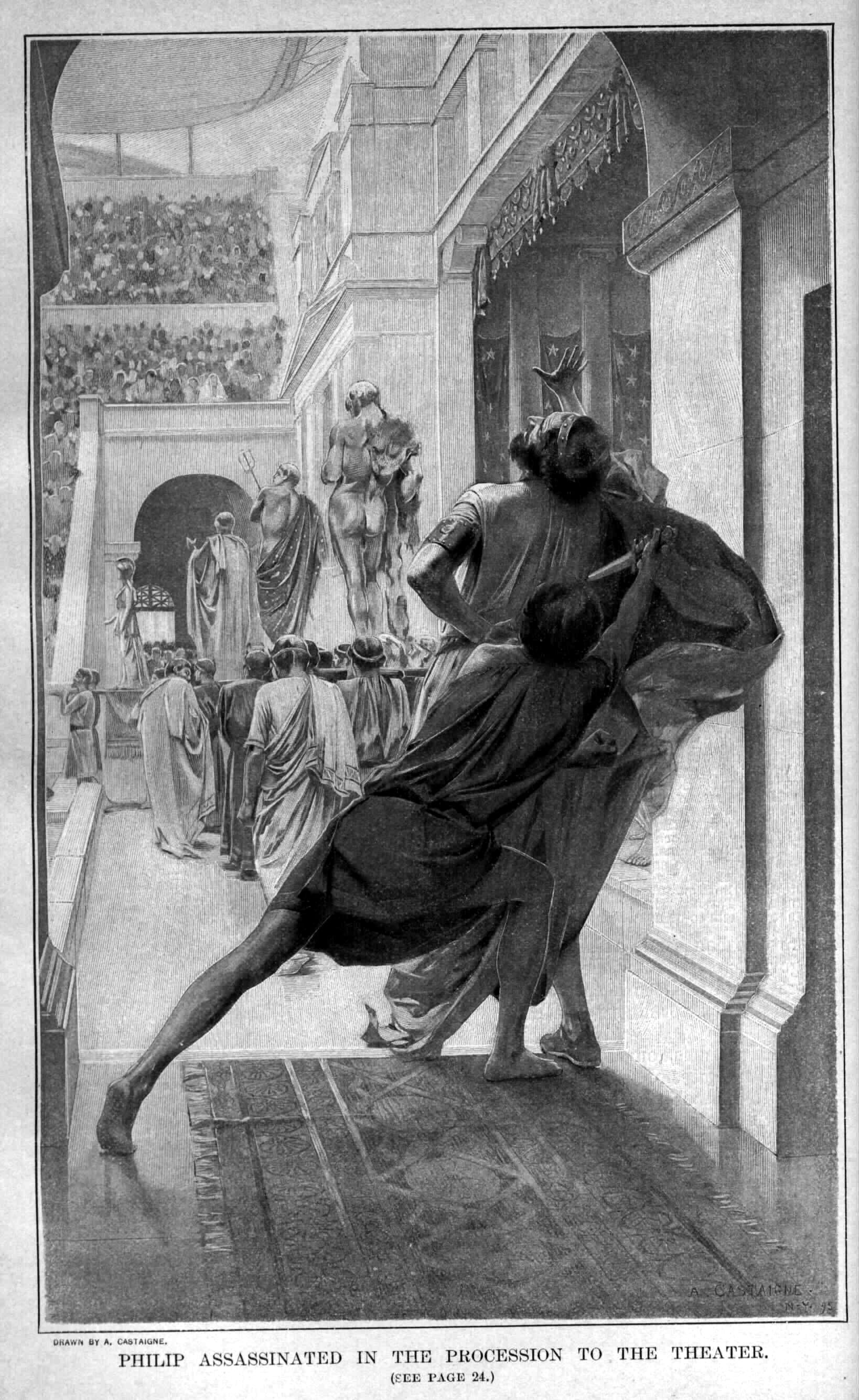
When Alexander of Macedon is twenty, his father Philip II is assassinated. He inherits a throne, a half-launched war against Persia, and two more big problems.
Tribes to the north who will raid Macedonia the moment the main army leaves.
Greek city-states waiting for an excuse to revolt.
Philip had spent years preparing the invasion. He had even built the League of Corinth to legitimize a war against Persia. When Philip is murdered, the expedition is left hanging.
Alexander makes the mission his own. But before he can safely leave for Asia, he has to deal with some immediate threats to his future.
These are war stories. The point of studying them is not necessarily to use them. Rather, to be aware of them. If you don’t, you won’t recognize them when they’re being used against you.
These strategies are interdisciplinary. Many world-changing insights do not come from deeper specialization inside one domain. They often come from taking knowledge that is ordinary in one area and applying it to another.
Text in block quotes is a direct quote from the book by Philip Freeman.
1. Thebes as a calculated demonstration · 335 BC
While Alexander fights the northern tribes, a rumor spreads that he is dead. The city of Thebes believes the rumor, and decides that now would be a good time to revolt. They kill or expel the Macedonian garrison in the fortified citadel inside the city, then declare independence, and call the rest of Greece to rise.
By themselves the Thebans were a powerful force, but if they were allowed to join with the Peloponnesian infantry and the Athenian navy — all backed by Persia — they could create a formidable alliance.
If Thebes succeeds, Athens follows. The Asia campaign we’ll die before it even gets started.
Alexander rides south at breakneck speed. He does not assault immediately. He camps outside the northern walls and gives Thebes time to reconsider. He does not want a war in Greece — every day spent there diminishes the chance of success in Asia.
Thebes votes unanimously to fight.
Then Alexander decides to make an example of Thebes.
He decided to utterly destroy the city. By this deliberate act of terror, he hoped to take the heart out of anyone who might rise against him in the future.” With this goal firmly in mind, Alexander called in his engineers to prepare siege engines and laid his plans to wipe Thebes off the map of Greece.
Freeman presents this not as a random act of cruelty but as a conscious political act. One terrifying demonstration is cheaper than leaving garrisons everywhere and racing home every time a city tests him.
And Alexander was correct.
When the news of the destruction of Thebes spread throughout Greece, the cities that had risen against Alexander rushed to explain that they had always, in fact, been on his side. The Arcadians who had sent a contingent of soldiers as far as Corinth voted to execute the leaders who had instigated the action. Other towns sent embassies to Alexander begging his forgiveness and assuring him of their undying loyalty to Macedonia. All of Greece suddenly remembered that they had never really cared for Thebes. Indeed, hadn’t the Thebans supported the hated Persians during the great war for Greek survival in the previous century? Certainly they deserved whatever evils had befallen them.
The principle
Make the cost of defection so high, and you will avoid constant mutinies or revolts. By striking fear into the Greek cities, Alexander was able to secure the rear for the next decade, even while he was thousands of miles away.
2. Defeating The Persian Navy · 334–332 BC
Alexander crosses into Asia Minor in the spring of 334 BC, at age twenty-one. He wins at the Granicus River. That victory creates a new problem: Persia still owns the sea. A superior navy can land behind him, cut supply lines, raid the Greek coast, and re-ignite the revolts he just snuffed out.
This is a tough position for Alexander. Do you stay and try to fight a naval battle? Do you ignore the Persian Navy and keep pushing inland on the quest to conquer Asia. Fortunately, Alexander the Great was a master strategist.
He does not fight the fleet on water. Ancient warships cannot stay at sea long. They need ports for water, food, repairs, and crew. If he could take their port cities, the Navy would have nowhere to go.
For two years he works down the coast of Asia Minor. After Thebes, some cities opened their gates and surrendered peacefully to Alexander. Some did not and required a siege.
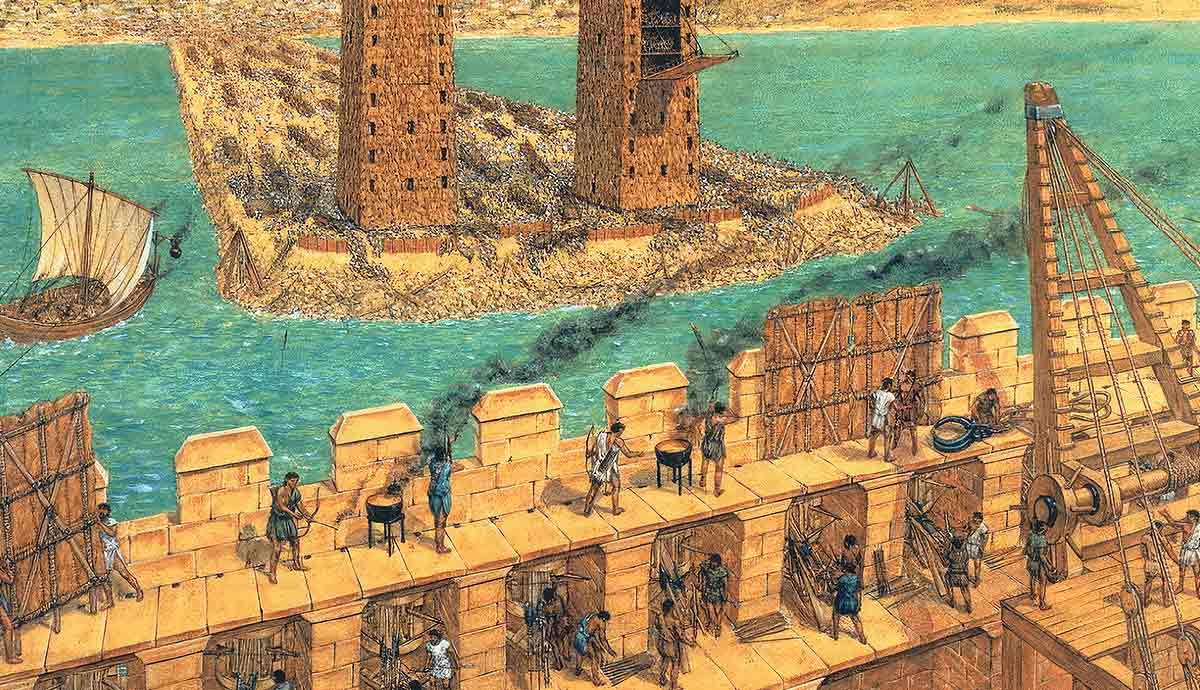
The coastal sidequest was slow and expensive, but it was the only move that made the rest of the campaign possible. With the rear secured and supply lines protected, Alexander turns to the interior.
The principle
Do not fight the opponent’s strength. Remove the conditions that strength depends on. A navy without ports is not a navy. A competitor without distribution is not a competitor.
These tactics can be anti-competitive and immoral, and I get that. The same can be said of Alexander’s destruction of Thebes. That’s exactly why you need to know them: if you don’t, you won’t recognize them when they’re being used against you.
3. The Night Before Gaugamela · 331 BC
Alexander is twenty-five now. Five years on campaign. Granicus and Issus already won. During the siege of Tyre, the King of Persia, Darius III, offered a generous peace that many senior officers wanted to take. Alexander refused.
Darius now gathers the largest army he can on a wide flat plain near Gaugamela, modern northern Iraq. He levels the ground for scythed chariots and plants traps. Alexander has roughly 47,000 men. Darius has at least twice that, maybe three or four times, depending on the source.
The Macedonians come over the last hill at dawn and look down on a hundred thousand Persians. A shudder runs through the army. The generals debate: attack now for surprise, or wait, survey the ground, and fight at first light. They wait. Alexander goes to his tent to sleep.
Parmenion comes alone with a different suggestion. Why not attack the Persians that very night while it was still dark? Alexander quickly rejected this, saying that he did not steal victories.
But Parmenion may have handed him the real idea.
The king would not attack that night, but why not let the Persians think he would? The ancient sources say that Darius was expecting Alexander to launch an assault in the dark and kept his men ready and awake all night in preparation. It could be that Alexander allowed word to spread through the ever-present network of Persian spies that the Macedonians were planning a surprise attack. Thus while his own men rested and prepared for the fight that was coming the next day, the Persian soldiers would be forced to remain awake all night under arms, waiting for an assault that would not come until sunrise. They would be exhausted, but the Macedonians would be ready to fight.
This strategy transfers into any competitive space where one side can shape the other side’s expectations and then exploit the cost of those expectations.
The modern version: Uber vs. Didi
In the early days, Uber needed customers, so they subsidized rides. That subsidy was not charity, and it was not the end goal. It was a tactic used to gain market share. If a competitor was offering a ride for $10 and Uber was offering that same ride for $5, the decision was a no-brainer for the customer. You were going to take the $5 ride. As the customer base got bigger, efficiencies began to appear.
This is exactly what Travis described on the David Senra podcast:
“Efficiency edge starts when somebody even downloads the app and signs up. If it’s easier to sign up on one versus another you have an efficiency edge. If it’s easier to call a vehicle and get it to you without problems, you have an efficiency edge because you’ll have less support. If the cars are moving to where the demand is because the driver app has good ways to point drivers to the right place that means you have shorter pickup time, that’s another efficiency edge. And efficiency edge means you get bigger faster.”
The context of all of this is that Uber is trying to enter the Chinese market. He says:
“I needed to subsidize rides to gain market share. When I gain market share there’s a network effect because if I’m bigger, then my system is more efficient and if I’m more efficient than them, they have to subsidize more than I do to compete with me.”
The larger company, Didi, backed by Chinese money, is now forced to keep burning cash to stay competitive. Every time they matched Uber’s prices or availability, they were paying a higher cost than Uber was, because Uber’s network had already lowered its own real cost of delivering the ride.
Now put the two pictures side by side.
On the plain at Gaugamela, Darius expects a night attack. Alexander reads that expectation, deliberately withholds the attack, and forces the larger army to stay up all night. They’re not burning cash, obviously, but they are burning energy. As a result, their ability to fight is weakened. They are less efficient than Alexander’s men, who have been able to get a good night’s rest.
In the Uber story, the larger player expects an aggressive fight for market share and is prepared to spend heavily to defend it. Uber forces that expenditure while its own subsidies are generating a real efficiency advantage. Anywhere a competitor is already braced for a particular aggressive action, you can force them to keep spending against the anticipation of that action while you improve your position. When you finally do move, you’re moving against a weakened opponent.
4. The Battle of Gaugamela
Alexander, however, did not fall into an easy sleep that night. He knew that the Persians outnumbered him at least two to one and that they had chosen a field of battle that played to their strengths. In a broad plain, the tens of thousands of horsemen drawn from every corner of the empire would easily stretch beyond his front lines and would certainly outflank him, enveloping his infantry until every last soldier was cut down. Or they could mass into an unstoppable wedge and force their way through his infantry. He had to think of a way to break through the Persian lines with his own cavalry and attack Darius directly. If he could kill the Great King or even drive him from the field, the Persian forces would collapse.
But why would it collapse?
What Alexander realized is that if you peel back the onion a little bit, the Persian army was not just the Persian army, but it was made up of all of these smaller factions.
Darius had called together Greek mercenaries, the Bactrians, the Sogdians, Indians, Mesopotamians, Arabs, Anatolians, and more.
All of these factions might be fighting on together on behalf of Darius, but it's because they have to, not because they want to. Darius was the single linchpin holding the massive, multi-national army together. If Alexander can basically cut the heart out of the Persian forces, he might be able to beat them without having to fight all of them.
Alexander had a plan. If he could draw enough of the Persian army away from their center after him, he might create a gap in their lines. At that moment, he would wheel his horsemen around and dash back to the opening before the Persian troops pursuing him could follow. There was so much that could go wrong with this plan that Alexander probably tried not to consider the consequences of failure. It depended on Darius sending enough troops after him to thin the Persian center. Then Alexander would have to turn his cavalry back fast enough to beat the enemy that would be chasing him. If he could make it, he would still have to force his way through a mass of Persian soldiers to attack Darius directly. All this time, the superior forces of the Great King would be attacking the rest of his army with everything they had. It was absolutely essential that Parmenion hold his troops together under the most punishing conditions long enough for Alexander to break through the hole he hoped to open in the Persian lines.
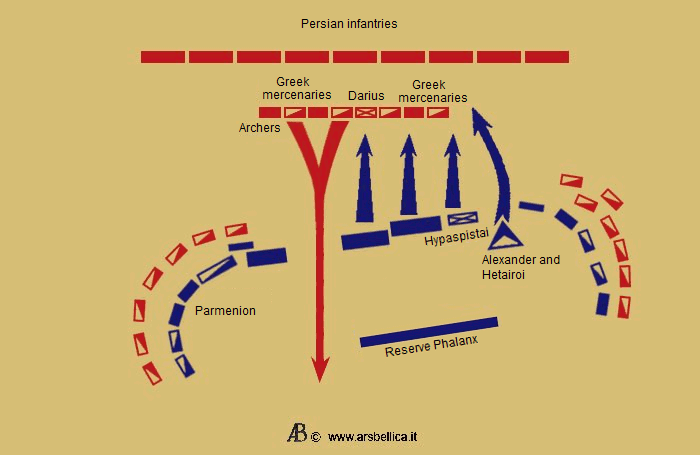
At last Alexander saw what he had been waiting for—a thinning in the Persian center. He ordered his men to turn sharply back and charge the opening in a wedge formation. The Persian forces on the right of the battlefield were kept in place by the Greek mercenaries and Paeonians, leaving the king free to race toward Darius. With a loud battle cry, Alexander and his men flew toward the Great King and charged into the Persian lines.
It was a brutal struggle on both sides, with Persian nobles laying down their lives to keep the Macedonians away from Darius. But at last Alexander and his men were drawing so close that the Great King ordered his charioteer to turn and flee the battlefield.
The principle
When you cannot match the opponent’s mass, do not fight the mass. Create a diversion that makes the mass move, and find the lynchpin.
5. The Helmet of Water · 325 BC
On the return to Macedonia, Alexander chooses one of the worst routes available, crossing the Gedrosian Desert — southern Pakistan and southeastern Iran today. The army is already worn down by years of war, Indian monsoons, and endless marching. Water is scarce, and the heat is brutal. Men fall by the hundreds, then thousands.
Near the end, scouts find a spring with only enough water to fill a single helmet. They bring it to Alexander. He is as thirsty as anyone. He pours it on the ground in full view of the army.
To the parched men, for their king to share in their suffering in this way meant more than the water soaking into the sand. They were so heartened, says Arrian, it was as if they had each drunk every drop that he poured on the ground.
The modern version: Tesla, 2017
Elon Musk has said he takes inspiration from Alexander. During Model 3 “production hell,” Tesla needed 5,000 cars a week and was stuck at two or three thousand. The company was bleeding. Workers were exhausted. Elon calls it “the most excruciatingly hellish several months that I have ever had.”
Instead of staying at a hotel across the street, he moved into the factory. The Fremont factory became his primary residence. He slept on a couch. At one point he put a tent on the roof. For a while he just slept on the floor under his desk in the open factory. He says that he would wake up smelling like metal dust. He wore the same clothes for five days straight. In an interview with Bloomberg, he says
“The reason I slept on the floor was not because I couldn’t go across the road and be at a hotel. It was because I wanted my circumstances to be worse than anyone else at the company. Whenever they felt pain, I wanted mine to be worse.”
In a separate interview, he expands on this:
“I slept on the floor under my desk so that during shift change, the entire team could see me. Since the team could see me sleeping on the floor during shift change, they knew I was there. That made a huge difference, and they gave it their all.”

This is the same principle Alexander used when he poured the water onto the sand. When the group is in extreme pain, the leader must make his own conditions equal to or worse than theirs, and he must do it where everyone can see it.
That’s all from me. See you next time.
- Dante
My Products
The Sunday Systems Weekly Planner (Free)


